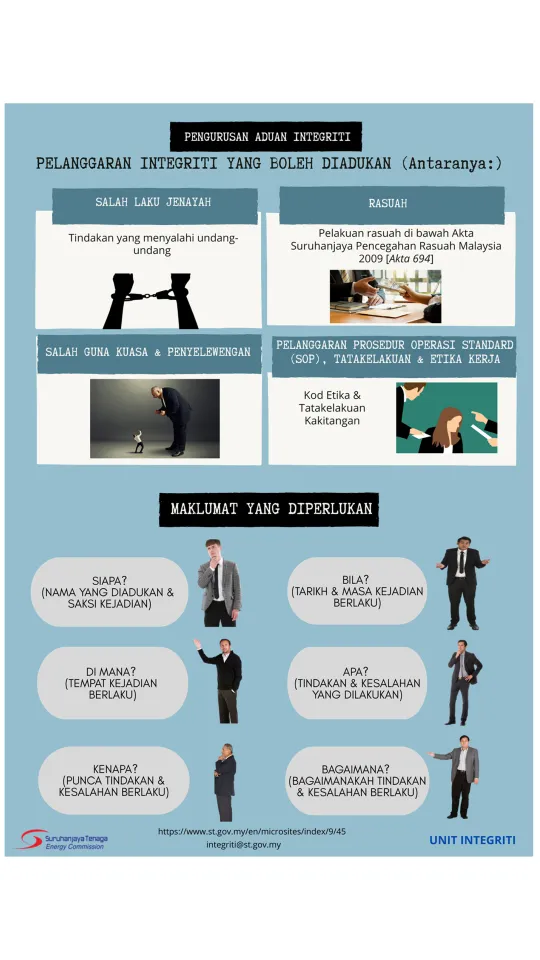
Guidelines For Making a Disclosure/Reporting
Definition
“Improper Conduct” means any conduct, complaint, information or disclosure which, if proven, would constitute a disciplinary offence or a criminal offence (hereinafter referred to as misconduct).
“Sensitive Information” includes:
- information relating to the identity, occupation, residential address, work address or whereabouts of:
- a whistleblower; and
- a person against whom the whistleblower has made a misconduct disclosure;
- information disclosed by a whistleblower; and
- information which, if disclosed, may cause harm to any person.
“Authorised Officer” means any officer of the Energy Commission who is appointed and empowered to carry out investigation and enforcement.
Making a Report
Reporting
- For disclosures made in person, the whistleblower shall attend at a place deemed appropriate and safe, as agreed, in order to provide information regarding the complaint to be made.
- For disclosures made by email, through the integrity complaint system or by letter, the handling and access to such information shall be controlled only by the Authorised Officer.
- The whistleblower may be required to appear in person or be contacted, depending on the circumstances, to provide further information or clarification in relation to the disclosure under investigation.
- A whistleblower may make an oral or written disclosure where, acting in good faith and on reasonable grounds, he or she believes that misconduct has occurred, is occurring or is likely to occur.
- A disclosure may be made by the whistleblower at any time after obtaining the relevant information or documents.
- Where the whistleblower genuinely believes that the misconduct or wrongdoing cannot be properly disclosed to the relevant authority, the whistleblower may make the disclosure voluntarily and shall be given due consideration for protection under this policy.
Conflict of Interest
A disclosure may be made directly to the Head of Integrity Unit in either of the following circumstances:
- where the disclosure involves misconduct by the Authorised Officer; or
- where the disclosure does not involve the Authorised Officer, but the whistleblower believes that the Authorised Officer has a personal interest in
- any person involved in the misconduct referred to in the disclosure.
- in the above circumstances, the Head of Integrity Unit may exclude the Authorised Officer from handling the disclosure and appoint any officer deemed suitable and qualified as a Special Authorised Officer to manage the disclosure and protect the whistleblower under this policy.
Where the disclosure involves the Head of Integrity Unit, the whistleblower may submit the information to the Authorised Officer, and the Authorised Officer shall submit the information / disclosure directly to the Chief Executive Officer without first referring it to the Head of Integrity Unit.
Procedure For Receiving a Complaint/ Information/Disclosure
The preliminary report may contain recommendations, including but not limited to the following:
- the disclosure is rejected because it is unfounded, contains false information, or the information provided is insufficient;
- the disclosure is considered for action under any other procedure considered appropriate;
- directing that further investigation be carried out on the disclosure; or
- referral to the police or any other relevant authority.
- if the complaint / information / disclosure received amounts to a criminal offence, it shall be referred to the relevant authorities, such as PDRM, SPRM or others; and
- if the complaint / information / disclosure received relates to the Energy Commission, the whistleblower shall be fully protected under this whistleblower protection policy or the relevant Act 711.
Protection Of The Whistleblower
ST must be know the identity of the Whistleblower
Any employee or member of the public intending to make a disclosure or report of misconduct must disclose his or her identity to ST in order to enable ST to provide protection under this policy and to facilitate ST in obtaining clarification or further information for investigation purposes. Anonymous disclosures will be disregarded and further action will only be taken where there is sufficient evidence to verify that the information received is genuine.
The whistleblower will be protected
A whistleblower who makes a report or disclosure of misconduct in good faith shall be afforded protection, and his or her identity shall be kept confidential to the extent reasonably practicable. Protection shall continue to be provided even if subsequent investigation reveals that the whistleblower was mistaken regarding the facts, rules, or procedures involved.
All reports and the identity of the whistleblower shall be handled in a careful and confidential manner. Reports shall only be disclosed to officers authorised to conduct investigations into the matters reported. The whistleblower’s identity shall remain confidential under all circumstances. The whistleblower shall be informed of the decisions and actions taken arising from the investigation conducted in respect of the information disclosed.
Notifcation
- 4.1 The whistleblower shall be informed by the Head of Integrity Unit of the outcome of the investigation and the action taken, if any, by the relevant disciplinary authority or other relevant authority.
-
4.2 The Energy Commission reserves the right to amend this policy from time to time.